This could be the penultimate post on this site. The PhD is in the bag, quite literally, for tomorrow morning I'll pick up the hard-bound copies from Joule library thesis binding service.
It's been quite a while since I last blogged. Almost two years. A symptom of being incredibly busy while finally rolling my sleeves up and writing the damn thesis. Regrettably, it came a little late, my funding ran out at the end of year 3 (autumn 2009) and rather unwisely I had to do most of my write-up in year 4 (2010). A lot happened in the run-up to autumn 2009, much of which was recorded on a blog elsewhere, but that's another story.
Whilst half-way through the write-up I thought paid employment would be a good thing and got myself a think tank policy wonk job. A year on, much blood, sweat and tears later, I can finally call myself a doctor. I don't think I was great company in the last 12 months or so, the pressure of it all got the best of me. But here we are, on the other side of the PhD experience.
In the last month or so I started in my new two-job arrangement. One with my old department at the university to pursue my academic interests, the other with the think thank. Consequently, I have no spare time to speak of and one really shouldn't continue like this for too long.
The PhD experience taught me a very important thing. Life is for living.
Thursday, 16 June 2011

Wednesday, 5 August 2009
Is there anything new about the Network Society?
My understanding of Castells' argument about the Network Society is that it triggers 'spatial transformation'.
The "new urban world" seems to be dominated by the double movement of inclusion into transterritorial networks and exclusion by the spatial separation of places. The higher the value of people and places, the more they are connected into interactive networks. The lower their value, the lower their connection.
The argument goes on, the networked people can by-pass the "local" thanks to their interconnectedness into these value-rich networks from which they benefit and from which the underprivileged are excluded.
"Gated communities", for example, are a manifestation of the Information Age insofar as they signal a "spatial separation" in the "space of places".
Value in our Information Society is increasinly transmitted and exchanged, or traded, via electronic networks that epitomise the "space of flows". The financial industry (and their infamous "masters of the universe" - most of whom are currently in hiding after the credit crunch) is a good example of what goes on in our world. The GDPs of certain metropolitan areas, such as New York, Paris and London exceed the GDPs of many sizeable nations (Brazil, Australia and Sweden respectively) (Graham, 2004).
Whilst hypothetically any place could have the connectivity in terms of infrastructure to facilitate the electronic exchanges required for economic success, why is it that only a handful of areas are "sticky" in that cash sticks to these elite "metropolitan heartlands". Low value activity, such as call centres, experience the "death of distance" thanks to ICTs, and are geographically removed from the place of consumption, but high-value activity, such as practised at the London Stock Exchange, remain in the central business districts of a handful of 'global cities'.
But what is new about this? Isn't this just another way of saying that the rich benefit from many privileges, whilst the poor have less choice? Is the Information Age adding anything new to this age old truth? And the argument about the select few places where all the money is made seems to support the view that "money goes to money". If the distribution of capital was less biased, we would be speaking of the Death of Capitalism, not the Death of Distance. Frankly, I can't see either showing any signs of fatal wounds.
"What about crowd sourcing, or the so-called long tail of the economy?" you might ask. Wasn't that supposed to transform the way the world works? Some people think the way Obama's political campaign was funded signaled a change in the realities of political economy.
I remain sceptical. Ok. Maybe there is potentially a lot of potential. I don't have to spell out what potential potential means, do I?
The "new urban world" seems to be dominated by the double movement of inclusion into transterritorial networks and exclusion by the spatial separation of places. The higher the value of people and places, the more they are connected into interactive networks. The lower their value, the lower their connection.
The argument goes on, the networked people can by-pass the "local" thanks to their interconnectedness into these value-rich networks from which they benefit and from which the underprivileged are excluded.
"Gated communities", for example, are a manifestation of the Information Age insofar as they signal a "spatial separation" in the "space of places".
Value in our Information Society is increasinly transmitted and exchanged, or traded, via electronic networks that epitomise the "space of flows". The financial industry (and their infamous "masters of the universe" - most of whom are currently in hiding after the credit crunch) is a good example of what goes on in our world. The GDPs of certain metropolitan areas, such as New York, Paris and London exceed the GDPs of many sizeable nations (Brazil, Australia and Sweden respectively) (Graham, 2004).
Whilst hypothetically any place could have the connectivity in terms of infrastructure to facilitate the electronic exchanges required for economic success, why is it that only a handful of areas are "sticky" in that cash sticks to these elite "metropolitan heartlands". Low value activity, such as call centres, experience the "death of distance" thanks to ICTs, and are geographically removed from the place of consumption, but high-value activity, such as practised at the London Stock Exchange, remain in the central business districts of a handful of 'global cities'.
But what is new about this? Isn't this just another way of saying that the rich benefit from many privileges, whilst the poor have less choice? Is the Information Age adding anything new to this age old truth? And the argument about the select few places where all the money is made seems to support the view that "money goes to money". If the distribution of capital was less biased, we would be speaking of the Death of Capitalism, not the Death of Distance. Frankly, I can't see either showing any signs of fatal wounds.
"What about crowd sourcing, or the so-called long tail of the economy?" you might ask. Wasn't that supposed to transform the way the world works? Some people think the way Obama's political campaign was funded signaled a change in the realities of political economy.
I remain sceptical. Ok. Maybe there is potentially a lot of potential. I don't have to spell out what potential potential means, do I?
Friday, 26 June 2009
"England is a very odd place" says Adrian Wooster from Community Broadband Network
So we discover that there is a certain urban advantage in England, which theoretically should benefit the majority of us (because ~60% of us live in densely populated areas). Us urban dwellers have a fighting chance of commercial development of next generation broadband (read: fibre). But - oh alas! BT owns an exclusive network of ducts in the ground in these urban areas, and there remains space within those ducts to accommodate fibre optic cables, so why would anyone want to take the risk and borrow a shedload of money to start digging up streets when BT could then (finally) decide to make a move? A bit anti-competitive, methinks.
Adrian Wooster Manch Euro
View more documents from Adrian Wooster.
Saturday, 20 June 2009
"The internet is as vital as water and gas" (Gordon Brown, 2009)
In a guest pen piece for the Times, The Prime Minister spoke in favour of rolling out "superfast broadband" because it "must benefit us all, business and consumers alike, in every part of the country". Who would disagree with that? Everyone sings from the same hymn sheet when it comes to the benefits of broadband access.
It is now, as the PM puts it, "as vital as water and gas".
Being an aspiring academic, I must problematise this argument. I would say that the internet is not as vital as water and gas, not just yet anyway, but it WILL BE as vital because services (such as seen in the field of e-health) are migrating to the online environment. It is a self-fulfilling prophecy.
Not in the too distant future, it is bad for your health, wealth and wellbeing not to have broadband at home. Your local services have all but closed, so if you can't do it online you probably face a considerable trek to wherever those services are discharged in a place-bound (old) fashion. There already are services which are delivered online only (not in the public sector though).
You won't know what's going on in your family or circle of friends unless you are part of their online social networks where they post their holiday pictures and their children's first utterings. Your employer, which could be a local authority even, might have forced to you work from home because your former work space is required for hot desking and you can only use it 2.5 days a week. Your colleagues have all opted for individualised patterns of work so you rarely see them for a catch-up, unless you chat to them online of course.
When did I become an internet pessimist? This is an inopportune time for me to adopt such dystopian views - having just upgraded my mobile phone to Nokia N96 which equips me with both 3G and wifi connectivity in the pocket (or handbag, more like).
That having said, I don't have gas or electricity in my handbag but water I do carry with me regularly.
It is now, as the PM puts it, "as vital as water and gas".
Being an aspiring academic, I must problematise this argument. I would say that the internet is not as vital as water and gas, not just yet anyway, but it WILL BE as vital because services (such as seen in the field of e-health) are migrating to the online environment. It is a self-fulfilling prophecy.
Not in the too distant future, it is bad for your health, wealth and wellbeing not to have broadband at home. Your local services have all but closed, so if you can't do it online you probably face a considerable trek to wherever those services are discharged in a place-bound (old) fashion. There already are services which are delivered online only (not in the public sector though).
You won't know what's going on in your family or circle of friends unless you are part of their online social networks where they post their holiday pictures and their children's first utterings. Your employer, which could be a local authority even, might have forced to you work from home because your former work space is required for hot desking and you can only use it 2.5 days a week. Your colleagues have all opted for individualised patterns of work so you rarely see them for a catch-up, unless you chat to them online of course.
When did I become an internet pessimist? This is an inopportune time for me to adopt such dystopian views - having just upgraded my mobile phone to Nokia N96 which equips me with both 3G and wifi connectivity in the pocket (or handbag, more like).
That having said, I don't have gas or electricity in my handbag but water I do carry with me regularly.
Friday, 5 June 2009
About the current crisis in government
Well I'm not sure actually that it is a crisis, as crises by definition should be sudden, unforeseen with some kind of immediate and severe impact on things in the short term. Take the economic crisis for example. Banks went under. People lost jobs. It was tangible. It was a crisis. People didn't see it coming. It was a shock to the system, like a decent crisis should be.
But the current crisis in government? That has been ongoing since the undemocratic appointment of Mr Brown as PM, following the long overdue departure of Mr Blair. There has been speculation and calls for the PM's beheading ever since, to the point of it becoming a bit boring. The Guardian columnist Polly Toynbee has been urging Labour to have a leadership contest for longer than I care to remember, and some sacrificial lambs in government have jumped ship along the way, crying out loud their disquiet about Mr Brown's leadership in their 15 seconds of coverage in the main news, soon forgotten about.
So now some more senior people have jumped ship (e.g. Smith, Blears, Purnell, Hutton). But the rebels have not been joined by the "presidential guards" as pointed out in the Guardian today. A revolt now is not a real threat to Mr Brown's premiership. By contrast, the next election will be. Polly, you have ask yourself, who in their right mind would want to take the Labour Party to the next general election? Gordon Brown, obviously, and the senior types are going to let him. Why would they want to be the leader for a few months only to lose the imminent election and get blamed for the defeat? Oh no, they're going to allow Mr Brown take the full hit. Alan Johnson, Toynbee's favourite leader-in-waiting, has emerged as the new Home Secretary in the current reshuffle.
My main problem is that it looks like we're going to have to live with a popular conservative administration for a while anyway, and that's not cricket.
But the current crisis in government? That has been ongoing since the undemocratic appointment of Mr Brown as PM, following the long overdue departure of Mr Blair. There has been speculation and calls for the PM's beheading ever since, to the point of it becoming a bit boring. The Guardian columnist Polly Toynbee has been urging Labour to have a leadership contest for longer than I care to remember, and some sacrificial lambs in government have jumped ship along the way, crying out loud their disquiet about Mr Brown's leadership in their 15 seconds of coverage in the main news, soon forgotten about.
So now some more senior people have jumped ship (e.g. Smith, Blears, Purnell, Hutton). But the rebels have not been joined by the "presidential guards" as pointed out in the Guardian today. A revolt now is not a real threat to Mr Brown's premiership. By contrast, the next election will be. Polly, you have ask yourself, who in their right mind would want to take the Labour Party to the next general election? Gordon Brown, obviously, and the senior types are going to let him. Why would they want to be the leader for a few months only to lose the imminent election and get blamed for the defeat? Oh no, they're going to allow Mr Brown take the full hit. Alan Johnson, Toynbee's favourite leader-in-waiting, has emerged as the new Home Secretary in the current reshuffle.
My main problem is that it looks like we're going to have to live with a popular conservative administration for a while anyway, and that's not cricket.
Thursday, 9 April 2009
It Is Not Easy To Set Alight a Van
But, fear not, the people of Levenshulme have good skills and will rise to such a challenge no bother.
Last night I was woken up by the sound of a fire engine about 30 yards from my bedroom window extinguishing the handiwork of Levenshulme's finest.
Ironically, this followed my efforts in the community front earlier in the day by organising a screening of the environmentally-conscious film WALL-E at a local primary school. I personally applied for a cash grant from the city council for this event, thinking it would be a good thing to do when the kids are bored during school holidays. The sponsporship enabled us to throw in a nice buffet for everyone afterwards.
Speaking to the Police Community Support Officer this morning who knocked on my door to ask if I had seen anything, I wanted to know if it was just a random act of vandalism. "We're treating it as such" the PCSO replied.
Yesterday's lessons are two-fold:
- yes, the kids ARE bored during school holidays
- no, organising an event will not make a blind bit of difference because it's all the good kids who come, the bad ones will be out and about trying to get their hands on petrol and other supplies required for a succesfull van-cum-bonfire.
Last night I was woken up by the sound of a fire engine about 30 yards from my bedroom window extinguishing the handiwork of Levenshulme's finest.
Ironically, this followed my efforts in the community front earlier in the day by organising a screening of the environmentally-conscious film WALL-E at a local primary school. I personally applied for a cash grant from the city council for this event, thinking it would be a good thing to do when the kids are bored during school holidays. The sponsporship enabled us to throw in a nice buffet for everyone afterwards.
Speaking to the Police Community Support Officer this morning who knocked on my door to ask if I had seen anything, I wanted to know if it was just a random act of vandalism. "We're treating it as such" the PCSO replied.
Yesterday's lessons are two-fold:
- yes, the kids ARE bored during school holidays
- no, organising an event will not make a blind bit of difference because it's all the good kids who come, the bad ones will be out and about trying to get their hands on petrol and other supplies required for a succesfull van-cum-bonfire.
Sunday, 1 March 2009
The tangled web of social networks
If you are reading this, then you probably have also heard about the recent debate on the health warnings about the extensive use of web 2.0 by our youngsters. The storm that raged about the use of social networking sites in particular took place in a teacup called the House of Lords, whipped up largely by one Baroness Greenfield .
You will not be surprised that the Daily Mail jumped on the bandwagon to broadcast the headline “Social websites harm children's brains: Chilling warning to parents from top neuroscientist“
Nor will it surprise you that the scientific evidence to support this claim has since been brought into question, and indeed Catherine Bennett had a go at Baroness Greenfield on the Comment page in the Observer today.
The problem I have with the entire debate is that of course the liberal front will attack the Baroness for expressing such “antiquated” opinions and borderline prejudice towards technology - that is the cool stance to take. And the House of Lords is an easy target. It is uncool, and just so 20th century, to be a sceptic when it comes to the infiltration of modern ICTs into our daily lives.
Simultaneously (paradoxically), it is hip to be very critical indeed of the use of ICTs by governments and the diffusion of (mass surveillance) technology. The division of labour in this debate is such that the cool kids warn us of “the erosion of freedoms” whilst the government officialdom are seen as the crude Orwellian technocrats who in their endless pursuit for more power (of information) will drain society of civil liberties (read about it here).
To point out the paradox, in case you wondered what it was, those who defend web 2.0 and social networking will happily plaster personal information about themselves all over the net, whilst concerns have been raised in another “cool camp” about the exploitation of this giant pool of data (volunteered by individuals) for commercial purposes (or indeed for something altogether more sinister). In fact, my own recent status update alerted fellow facebookers to this piece of news. (erm, no one batted an eyelid)
Make what you wish of this debate, or choose a side even. What I am going to do instead is to add another, a rather more blogite, layer to it.
I want talk about the perils of social networking, not because I believe that it is going to “rewire your brain” (which is what Baroness Greenfield would have you believe) and therefore make you suffer from permanent ADHD. Nor because it looks like facebook might sell the right to access your personal information to faceless multinationals.
The subject of this post, admittedly after a lengthy introduction, is the potential personal cost of exposure to online social networks. I am about to discuss some observations made since giving up on my resistance to join the facebook frenzy back in October 2007.
A personal and well, yes, at times funny, article by Georgina Hobbs-Meyer appeared in the Guardian a while ago about the break-up of one marriage and how it all played out on facebook. Reference was naturally made to the infamous case of Chelsy Davy’s relationship status update. Albeit slightly naively written from the perspective of a 24-year old (/young) woman discovering her husband having an affair with a "younger woman" aged 19 (yes, it's all relative, isn't it?), it made me want to add my tuppence worth on the broader topic of social networking.
Today’s comment in the Observer by Catherine Bennett touches very lightly upon a previously uncharted territory of twittering about the end of your life – something she (surprisingly) attributes to “an older subscriber” - "looking down at my grey motionless body". I was struck by that assumption made about the nearness of death and old age particularly as none of us has been spared from the poor Jade Goody making a very public affair of her terminal cancer.
A friend of mine has become a twitter fan of Stephen Fry, Russell Brand and “Wossy” (who all tweet generously) and therefore I, too, have some exposure to the sort of things these gentlemen choose to broadcast about their daily lives. If Jade Goody was a twitterer (I don’t know if she is) her tweets would surely make a good case study of this emerging concept of web 2.0, social networks, exhibitionism and death. Then again, due to the very nature of web 2.0, there’s no money to be made from twittering your cancer diary (the attention economy has nothing to do with cash exchanging hands) - a fair assumption then that Jade Goody does not twitter, about her illness anyway.
Back to my sentiments/observations about facebook – or should I say fakebook: people post updates and photos portraying an image of them as party animals, looking gorgeous and being on top of the world generally. I heard recently of an encounter where a friend had met someone in the flesh and could not have recognised them on the basis of their profile picture (looking like a sex goddess, the truth being far from it). I, too, know of one or two people who might be guilty of faking it on facebook. That having said, I don’t know of any women who would post an entirely unflattering image of themselves, but there is a distinction to be made between flattering and unrealistic. Mind, once on facebook most of us are exposed to (un)helpful friends tagging us in photos looking… well… realistic.
Georgina Hobbs-Meyer’s account talks about discovering your husband having cyber-sex, thus she writes quite scornfully about the hedonistic side of facebook, and also of the dark side of becoming obsessed with using the tool to consume every bit of information you can about someone else.
In my social network I have witnessed an ex-lover hacking into their former love interest's facebook account and causing havoc. Another person inadvertently disclosed to a number of people through facebook about their recent miscarriage, and for good measure the same thread contained intimate details of her friend’s relationship break down. Not so much a slip of the tongue, but a slip of the finger. Thanks to facebook’s functionality, emails were sent to a whole host of unintended recipients.
The tangled web of social networks is such that it could happen to you - be warned.
You will not be surprised that the Daily Mail jumped on the bandwagon to broadcast the headline “Social websites harm children's brains: Chilling warning to parents from top neuroscientist“
Nor will it surprise you that the scientific evidence to support this claim has since been brought into question, and indeed Catherine Bennett had a go at Baroness Greenfield on the Comment page in the Observer today.
The problem I have with the entire debate is that of course the liberal front will attack the Baroness for expressing such “antiquated” opinions and borderline prejudice towards technology - that is the cool stance to take. And the House of Lords is an easy target. It is uncool, and just so 20th century, to be a sceptic when it comes to the infiltration of modern ICTs into our daily lives.
Simultaneously (paradoxically), it is hip to be very critical indeed of the use of ICTs by governments and the diffusion of (mass surveillance) technology. The division of labour in this debate is such that the cool kids warn us of “the erosion of freedoms” whilst the government officialdom are seen as the crude Orwellian technocrats who in their endless pursuit for more power (of information) will drain society of civil liberties (read about it here).
To point out the paradox, in case you wondered what it was, those who defend web 2.0 and social networking will happily plaster personal information about themselves all over the net, whilst concerns have been raised in another “cool camp” about the exploitation of this giant pool of data (volunteered by individuals) for commercial purposes (or indeed for something altogether more sinister). In fact, my own recent status update alerted fellow facebookers to this piece of news. (erm, no one batted an eyelid)
Make what you wish of this debate, or choose a side even. What I am going to do instead is to add another, a rather more blogite, layer to it.
I want talk about the perils of social networking, not because I believe that it is going to “rewire your brain” (which is what Baroness Greenfield would have you believe) and therefore make you suffer from permanent ADHD. Nor because it looks like facebook might sell the right to access your personal information to faceless multinationals.
The subject of this post, admittedly after a lengthy introduction, is the potential personal cost of exposure to online social networks. I am about to discuss some observations made since giving up on my resistance to join the facebook frenzy back in October 2007.
A personal and well, yes, at times funny, article by Georgina Hobbs-Meyer appeared in the Guardian a while ago about the break-up of one marriage and how it all played out on facebook. Reference was naturally made to the infamous case of Chelsy Davy’s relationship status update. Albeit slightly naively written from the perspective of a 24-year old (/young) woman discovering her husband having an affair with a "younger woman" aged 19 (yes, it's all relative, isn't it?), it made me want to add my tuppence worth on the broader topic of social networking.
Today’s comment in the Observer by Catherine Bennett touches very lightly upon a previously uncharted territory of twittering about the end of your life – something she (surprisingly) attributes to “an older subscriber” - "looking down at my grey motionless body". I was struck by that assumption made about the nearness of death and old age particularly as none of us has been spared from the poor Jade Goody making a very public affair of her terminal cancer.
A friend of mine has become a twitter fan of Stephen Fry, Russell Brand and “Wossy” (who all tweet generously) and therefore I, too, have some exposure to the sort of things these gentlemen choose to broadcast about their daily lives. If Jade Goody was a twitterer (I don’t know if she is) her tweets would surely make a good case study of this emerging concept of web 2.0, social networks, exhibitionism and death. Then again, due to the very nature of web 2.0, there’s no money to be made from twittering your cancer diary (the attention economy has nothing to do with cash exchanging hands) - a fair assumption then that Jade Goody does not twitter, about her illness anyway.
Back to my sentiments/observations about facebook – or should I say fakebook: people post updates and photos portraying an image of them as party animals, looking gorgeous and being on top of the world generally. I heard recently of an encounter where a friend had met someone in the flesh and could not have recognised them on the basis of their profile picture (looking like a sex goddess, the truth being far from it). I, too, know of one or two people who might be guilty of faking it on facebook. That having said, I don’t know of any women who would post an entirely unflattering image of themselves, but there is a distinction to be made between flattering and unrealistic. Mind, once on facebook most of us are exposed to (un)helpful friends tagging us in photos looking… well… realistic.
Georgina Hobbs-Meyer’s account talks about discovering your husband having cyber-sex, thus she writes quite scornfully about the hedonistic side of facebook, and also of the dark side of becoming obsessed with using the tool to consume every bit of information you can about someone else.
In my social network I have witnessed an ex-lover hacking into their former love interest's facebook account and causing havoc. Another person inadvertently disclosed to a number of people through facebook about their recent miscarriage, and for good measure the same thread contained intimate details of her friend’s relationship break down. Not so much a slip of the tongue, but a slip of the finger. Thanks to facebook’s functionality, emails were sent to a whole host of unintended recipients.
The tangled web of social networks is such that it could happen to you - be warned.
Thursday, 5 February 2009
Former Fan of Wintry Weather
Winter used to be my favourite season, and yes that sounds perverse coming from someone who is from Finland - a country where everyone moans about the length and breadth of winter, and conversely, praises the sweetness of the short-lived summer.
Not me though, I used to love the winter, always. The darkness I didn't mind, in fact, when evening wrapped its thick dark blanket around the landscape from 3 pm onwards, I felt strangely alive. Alive, I guess, because it made me acutely aware of the changing seasons and all that comes with it. Plus you could go out at 6 pm, lie on your back against the snow and gaze at the starry sky, engulfed in blackness. Blackness that is in fact made up of whiteness, zillions of little glistening snow crystals reflecting light from the stars above. It feels like floating in space - although I've never floated in space, I used to imagine that's what it must be like for the astronauts.
Winter used to be special.
So what happened? For quite a while after moving to England I would still get excited over a bit of snow, or frost even, being reminded of the magic that was winter. Not that we'd get too many days in a year with decent frost in Manchester; the Pennines, the Irish Sea and an urban micro climate make sure that wintry conditions are a rarety in these parts. Even now when the rest of the country, it seems, has had a foot of snow or more, there's hardly any evidence of the white stuff in and around South Manchester.
But my recent turn against wintry weather has nothing to do in fact with snow, the lack thereof, or the reported chaos in those parts of the UK blessed/cursed with a fair dose of it. Although I do feel sorry for all those people stranded at airports and such like, I know what that feels like having been grounded at Copenhagen once for 17 hours due to a blizzard.
It's the fact that I can't get warm in the winter that does it for me. The house I co-own has loft insulation, additional underfloor insulation, double-glazed windows and central heating (goes without saying if you ask me, but let's just say it anyway).
When the weather is cool (that's to say, approximately 8 months of the year in Manchester) I wear woolly socks around the house, layers upon layers of clothes, often a fleece, and when I sit down I have to wrap myself in a blanket like an old squaw.
I am known to have worn all of the above to bed as well, because there's nothing more unpleasant than slipping in between cold sheets if you ask me - the bed feeling like a block of ice underneath you (of course, ironically the opposite is true in the summer, but this is not summer, is it?).
I almost begin to see the point of hot water bottles and electric blankets, but still after 9 years I stand proud (and cold) thinking that I will not be caught with such items. Also, I have a slight phobia of being electrocuted in bed due to some dodgy wiring in the blanket "made in home town" as Xiaolu Guo would put it (for those who haven't had the pleasure of A Concise Chinese-English Dictionary for Lovers, it's well worth a read).
As a former fan of wintry weather, I still enjoy the aesthetic improvements that snow brings upon the Manchester streetscape, it makes it very Lowry-esque, methinks.
But let it be known that I am oh-so-sick of being cold.
Not me though, I used to love the winter, always. The darkness I didn't mind, in fact, when evening wrapped its thick dark blanket around the landscape from 3 pm onwards, I felt strangely alive. Alive, I guess, because it made me acutely aware of the changing seasons and all that comes with it. Plus you could go out at 6 pm, lie on your back against the snow and gaze at the starry sky, engulfed in blackness. Blackness that is in fact made up of whiteness, zillions of little glistening snow crystals reflecting light from the stars above. It feels like floating in space - although I've never floated in space, I used to imagine that's what it must be like for the astronauts.
Winter used to be special.
So what happened? For quite a while after moving to England I would still get excited over a bit of snow, or frost even, being reminded of the magic that was winter. Not that we'd get too many days in a year with decent frost in Manchester; the Pennines, the Irish Sea and an urban micro climate make sure that wintry conditions are a rarety in these parts. Even now when the rest of the country, it seems, has had a foot of snow or more, there's hardly any evidence of the white stuff in and around South Manchester.
But my recent turn against wintry weather has nothing to do in fact with snow, the lack thereof, or the reported chaos in those parts of the UK blessed/cursed with a fair dose of it. Although I do feel sorry for all those people stranded at airports and such like, I know what that feels like having been grounded at Copenhagen once for 17 hours due to a blizzard.
It's the fact that I can't get warm in the winter that does it for me. The house I co-own has loft insulation, additional underfloor insulation, double-glazed windows and central heating (goes without saying if you ask me, but let's just say it anyway).
When the weather is cool (that's to say, approximately 8 months of the year in Manchester) I wear woolly socks around the house, layers upon layers of clothes, often a fleece, and when I sit down I have to wrap myself in a blanket like an old squaw.
I am known to have worn all of the above to bed as well, because there's nothing more unpleasant than slipping in between cold sheets if you ask me - the bed feeling like a block of ice underneath you (of course, ironically the opposite is true in the summer, but this is not summer, is it?).
I almost begin to see the point of hot water bottles and electric blankets, but still after 9 years I stand proud (and cold) thinking that I will not be caught with such items. Also, I have a slight phobia of being electrocuted in bed due to some dodgy wiring in the blanket "made in home town" as Xiaolu Guo would put it (for those who haven't had the pleasure of A Concise Chinese-English Dictionary for Lovers, it's well worth a read).
As a former fan of wintry weather, I still enjoy the aesthetic improvements that snow brings upon the Manchester streetscape, it makes it very Lowry-esque, methinks.
But let it be known that I am oh-so-sick of being cold.
Wednesday, 21 January 2009
"PhD's are not good for you"
Wise words from our Professor, the formidable Cecilia Wong when she spotted me back at my desk the day before yesterday after a period of absence/interruption.
My supervisor had told her about the calamity in my life on all fronts. I don't generally half-do things, so perhaps it is just as well that I have a full-blown crisis in all departments.
I do remember attending a "welcome talk" by the Dean of the School to all new PhD students some 2.5 years ago, and she quoted bleak statistics. So many of us would never complete, so many will end up in a relationship break down and so many will face some other untoward incident the likelihood of which goes up with aspirations for high academic achievement.
The evidence was there, PhD's are not good for you. My good friend and fellow PhD candidate and I didn't think those statistics had anything to do with us - we were mature, sorted and settled sort of people. We were in long-term established relationships with careers and mortgages, after all. So what's the worst that can happen?
Your dad dies, you spend 3 months of a year abroad, fuck up your long term relationship and find yourself looking for somewhere to live, with a major backlog of work that makes your stomach turn.
It's time for serious self discipline and a ban on foreign holidays (that includes conferences, but not any long weekend type city breaks that one's mother is likely to initiate).
Maybe it'll all be worth it in the end?
My supervisor had told her about the calamity in my life on all fronts. I don't generally half-do things, so perhaps it is just as well that I have a full-blown crisis in all departments.
I do remember attending a "welcome talk" by the Dean of the School to all new PhD students some 2.5 years ago, and she quoted bleak statistics. So many of us would never complete, so many will end up in a relationship break down and so many will face some other untoward incident the likelihood of which goes up with aspirations for high academic achievement.
The evidence was there, PhD's are not good for you. My good friend and fellow PhD candidate and I didn't think those statistics had anything to do with us - we were mature, sorted and settled sort of people. We were in long-term established relationships with careers and mortgages, after all. So what's the worst that can happen?
Your dad dies, you spend 3 months of a year abroad, fuck up your long term relationship and find yourself looking for somewhere to live, with a major backlog of work that makes your stomach turn.
It's time for serious self discipline and a ban on foreign holidays (that includes conferences, but not any long weekend type city breaks that one's mother is likely to initiate).
Maybe it'll all be worth it in the end?
Monday, 8 December 2008
The Pun of the Year 2008
"it seems to me that you can already maintain your stroke well over the length"
adding to that,
"Also you're receptive to learning new skills"
"Also you're receptive to learning new skills"
said my swimming instructor to me this morning, and in so doing put a smile on my face. The funniest thing about it is that I don't think the instructor meant to sound so ruthlessly carry-on. This is just normal swimming talk.
I signed up for tutored swimming classes run by the University's Swimming Club this semester in order to "improve my technique and stamina" in the pool.
I was allocated a place in the middle group which has meant quite a wide variety of skills amongst us. A very wide spectrum indeed. I've enjoyed it nevertheless although I've missed a good few sessions due to being in various locations in the world, frankly, anywhere but Manchester. There's only one final session left and we received an email about enrolling to the continuation classes over the Spring term.
Yes please, I thought, but I could do with a challenge. Should I suggest moving up to the advanced class?
The answer lies in the stroke - maintained over the length, mind, one is not to stall or slow down half way up the length, that does not earn you a place in the advanced group.
From there on you build your stamina to maintain the stroke over longer sessions (or greater lengths). Can't wait.
Saturday, 6 December 2008
Pause for thought
I should start this post by wishing Finland a very happy 91st birthday. The Finnish Independence Day is a big deal at home, and to prove the point I, too, gathered with a number of compatriots at the Ambassador's Independence Day reception at his official residence last night. To my defence I would have had to make a trip to the Embassy anyway to pick up a certificate which the Finnish authorities require in dealing with my father's estate. Today, the President of the Republic hosts her own (televised) reception which the entire nation follows with interest: who's been invited, who wears what (the fashionistas making live commentary online, such this one from 2007), who's on their own and who launches a new partner by their side on the red carpet. The sombre and serious cause of our nation's independence has been turned into one of the biggest showbiz extravaganzas of the year. Go figure.
 It's been a bit quiet on this blog since my trip to Australia, from where I continued to Shanghai and Nanjing for a quick look around. China was a real eye-opener, but Sydney impressed me most (pictured left). Beautiful city, great weather, food to die for at reasonable prices. Perfect for a holiday. The only problem is of course the hideously long journey to get there from almost anywhere in the world, bar New Zealand perhaps.
That having said, Shanghai was intriguing to say the least, it was at the Urban Plan ning Exhibition opposite to the People's Square where I saw this gigantic model of Shanghai (pictured right). I reckon it's the only way to get a proper grip of the city - once you're in it the high rises, complex motorway flyovers and little narrow alleys merge into this one giant bowl of noodles. An enourmous pulsating beast of a city. Only by looking at the city physically at your feet you understand what's where and the scale of it. Particularly if you only have three days as in my case. In 2010 Shanghai will host the World Expo, and having looked at the displays of the various Pavilions, and the plans for huge redevelopment of the river side where the Exhibition Village is going to be built, one is almost tempted to go back to have a look at it in 2 years time. As a peculiar little detail, the authorities have launched a "better city, better life" campaign as part of which for example the extent of spitting that happens in the city will be curtailed. Yep, that's right, spitting.
The day before I was due to leave Manchester for Melbourne I received a phone call from home - it was mum saying dad had been taken into hospital. 16 days later when I came back I had a hectic 5 days in Manchester before dashing off to Finland for a surprise visit on Father's Day. I was supposed to come back straight away and crack on with my PhD but that was not going to happen. Dad's condition deteriorated suddenly, so I decided it would be a bad move to return to England. Only four days later he passed away. Even the nurses were shocked at the speed of his decline. They assured us it was actually a good thing, in the case of a combined liver and heart failure it's not a nice experience for anyone to hang around for a prolonged period of time.
So my research was put on the back burner. I have officially "interrupted" my studies for 3 months, starting from 1st November until 31st January 09. This is to give me more time to spend at home over the Christmas period and generally to take stock.
2008 has been a very, very hectic year. I have contemplated on my carbon footprint - in the space of 11 months I have been to Madrid, Amsterdam, Florence, Helsinki (7 weeks), Cinque Terra, Nice, Marseille, Melbourne, Sydney, Shanghai and Nanjing. Oh, and then Helsinki again.
Things will be different next year.
 It's been a bit quiet on this blog since my trip to Australia, from where I continued to Shanghai and Nanjing for a quick look around. China was a real eye-opener, but Sydney impressed me most (pictured left). Beautiful city, great weather, food to die for at reasonable prices. Perfect for a holiday. The only problem is of course the hideously long journey to get there from almost anywhere in the world, bar New Zealand perhaps.
That having said, Shanghai was intriguing to say the least, it was at the Urban Plan
ning Exhibition opposite to the People's Square where I saw this gigantic model of Shanghai (pictured right). I reckon it's the only way to get a proper grip of the city - once you're in it the high rises, complex motorway flyovers and little narrow alleys merge into this one giant bowl of noodles. An enourmous pulsating beast of a city. Only by looking at the city physically at your feet you understand what's where and the scale of it. Particularly if you only have three days as in my case. In 2010 Shanghai will host the World Expo, and having looked at the displays of the various Pavilions, and the plans for huge redevelopment of the river side where the Exhibition Village is going to be built, one is almost tempted to go back to have a look at it in 2 years time. As a peculiar little detail, the authorities have launched a "better city, better life" campaign as part of which for example the extent of spitting that happens in the city will be curtailed. Yep, that's right, spitting.The day before I was due to leave Manchester for Melbourne I received a phone call from home - it was mum saying dad had been taken into hospital. 16 days later when I came back I had a hectic 5 days in Manchester before dashing off to Finland for a surprise visit on Father's Day. I was supposed to come back straight away and crack on with my PhD but that was not going to happen. Dad's condition deteriorated suddenly, so I decided it would be a bad move to return to England. Only four days later he passed away. Even the nurses were shocked at the speed of his decline. They assured us it was actually a good thing, in the case of a combined liver and heart failure it's not a nice experience for anyone to hang around for a prolonged period of time.
So my research was put on the back burner. I have officially "interrupted" my studies for 3 months, starting from 1st November until 31st January 09. This is to give me more time to spend at home over the Christmas period and generally to take stock.
2008 has been a very, very hectic year. I have contemplated on my carbon footprint - in the space of 11 months I have been to Madrid, Amsterdam, Florence, Helsinki (7 weeks), Cinque Terra, Nice, Marseille, Melbourne, Sydney, Shanghai and Nanjing. Oh, and then Helsinki again.
Things will be different next year.
Saturday, 25 October 2008
Lessons in life and coffee at Pellegrini's
After my first sweaty day in Melbourne, dinner in the form of rice paper rolls from a street side stall in the Block Arcade, I thought a few drinks would be in order. I tried two different rooftop bars, since the weather was more than favourable for al fresco drinking, I would recommend both for anyone who wants to soak up the atmosphere of cosmopolitan Melbourne in stylish surroundings. The first place was upstairs of an Tuscan restaurant on Bourke Street, the other the famous Supper Club on Spring Street.
The former was more relaxed, the latter perhaps bordering on pretentious but with fabulous views overlooking the Parliament building and a very exclusive atmosphere (and wine list, you could order a bottle of plonk for a reassuring $600. Needless to say I didn’t). I did, however, try some very nice Aussie wines – the nicest one actually served in the first place I went to, the less salubrious of the two rooftop joints.
Earlier in the day I had walked past an Italian espresso bar called Pellegrini’s (pictured below). It caught my eye for many reasons so I earmarked the place for a visit later in the day. The way to describe it is that this place was the perfect antidote to the Starbucks generation of coffee bar chains which have mushroomed all over Melbourne. Pellegrini's oozed individuality and old fashioned charm.
I didn’t expect Pellegrini’s to be open when I was walking home from the Supper Club, jetlagged and exhausted with the heat, around 10 pm. Cafes generally seem to close around 5 or 6 pm in Melbourne, but not Pellegrini’s.
I stepped in, and it felt like I travelled back in time and found myself on the scene of a Federico Fellini film. Not the least because the owner of the place, a gregarious Italian gentleman called Sisto, greeted me with a beaming smile and called me “la bella”. Take a seat here, bella, now what would you like? Espresso, here, is that good for you? Do you like it shorter or taller? A little bit of gelato, there you are, lemon and vanilla. Home made. Try it!
I popped in for a quick espresso on the way home, and ended up being served espresso, gelato, lemonade and two pasta dishes before Sisto offered to drop me off at the hostel at closing time (midnight). I refused the lift, and insisted on walking home to get some fresh air.
In the kitchen of his espresso bar, when I was tucking into some ravioli and pasta marinare, Sisto declared that “If I was 30 years younger, I would ask you to marry me tomorrow”. Awh.
Sisto introduced me to Pellegrini’s “resident artist”, a Kiwi lady called Louise. Louise had spent the past two months in Melbourne finishing her book. She also sings, plays the guitar and writes poetry, mainly in Pellegrini’s when she in Melbourne.
The trouble with being treated like this is payment. I asked Louise for advice, as Sisto would clearly refuse any offer of money. I slipped $20 onto the tip tray which was spotted by one of the staff. Rosie, the vigilant Italian lady, at the end of the night, took out my $20 note and handed it back to me, saying it was too much. “If you give me $5”, she said, “I’ll accept it”. I gave her $10. She handed me a fiver back. Did you ever have to do reverse haggling? Bizarre.
In the course of the week, I went back to Pellegrini’s almost every day. In the kitchen, Sisto taught me everything I need to know about the art of coffee, and cooking pasta “the proper way”.
Coffee is not just a drink, it’s nourishment for the soul. The way they serve it in Pellegrini’s, I have to agree.
The former was more relaxed, the latter perhaps bordering on pretentious but with fabulous views overlooking the Parliament building and a very exclusive atmosphere (and wine list, you could order a bottle of plonk for a reassuring $600. Needless to say I didn’t). I did, however, try some very nice Aussie wines – the nicest one actually served in the first place I went to, the less salubrious of the two rooftop joints.
Earlier in the day I had walked past an Italian espresso bar called Pellegrini’s (pictured below). It caught my eye for many reasons so I earmarked the place for a visit later in the day. The way to describe it is
 that this place was the perfect antidote to the Starbucks generation of coffee bar chains which have mushroomed all over Melbourne. Pellegrini's oozed individuality and old fashioned charm.
I didn’t expect Pellegrini’s to be open when I was walking home from the Supper Club, jetlagged and exhausted with the heat, around 10 pm. Cafes generally seem to close around 5 or 6 pm in Melbourne, but not Pellegrini’s.
I stepped in, and it felt like I travelled back in time and found myself on the scene of a Federico Fellini film. Not the least because the owner of the place, a gregarious Italian gentleman called Sisto, greeted me with a beaming smile and called me “la bella”. Take a seat here, bella, now what would you like? Espresso, here, is that good for you? Do you like it shorter or taller? A little bit of gelato, there you are, lemon and vanilla. Home made. Try it!
I popped in for a quick espresso on the way home, and ended up being served espresso, gelato, lemonade and two pasta dishes before Sisto offered to drop me off at the hostel at closing time (midnight). I refused the lift, and insisted on walking home to get some fresh air.
In the kitchen of his espresso bar, when I was tucking into some ravioli and pasta marinare, Sisto declared that “If I was 30 years younger, I would ask you to marry me tomorrow”. Awh.
Sisto introduced me to Pellegrini’s “resident artist”, a Kiwi lady called Louise. Louise had spent the past two months in Melbourne finishing her book. She also sings, plays the guitar and writes poetry, mainly in Pellegrini’s when she in Melbourne.
The trouble with being treated like this is payment. I asked Louise for advice, as Sisto would clearly refuse any offer of money. I slipped $20 onto the tip tray which was spotted by one of the staff. Rosie, the vigilant Italian lady, at the end of the night, took out my $20 note and handed it back to me, saying it was too much. “If you give me $5”, she said, “I’ll accept it”. I gave her $10. She handed me a fiver back. Did you ever have to do reverse haggling? Bizarre.
In the course of the week, I went back to Pellegrini’s almost every day. In the kitchen, Sisto taught me everything I need to know about the art of coffee, and cooking pasta “the proper way”.
Coffee is not just a drink, it’s nourishment for the soul. The way they serve it in Pellegrini’s, I have to agree.
Saturday, 18 October 2008
You'll be allright for as long as you're not in rubber thongs
It was a promising start for the journey, despite my initial fears that 60 minutes between arrival at the infamous Terminal 5 and departure towards Melbourne (via Hong Kong) from Terminal 4 at Heathrow was cutting it a tad fine. The transfer guide in the seat pocket onboard the BA flight Manchester-Heathrow advised passengers to allow 120 minutes to transfer between T5 and T4. An hour would have just about done it, but as it happened, the Qantas flight to
This second leg of the journey was gruesome. Mercifully, I had a window seat and the two seats next to me were occupied by a very nice Dutch couple in their 50’s, no screaming children anywhere near.
The problems started some time after the main meal: “greek beef” with very suspicious mini bottle of red wine with a long list of additives. I want to know why wine always tastes shocking during flights, is it just the quality of the wine (sub-standard) or is there something about serving wine at that altitude/atmosphere that is best avoided? After the food was served, coffees drunk and everyone snug in their seats somewhere over
Up until that point I hadn’t familiarised with the in-flight entertainment kit, I had been too busy reading “Le Dossier” (or how to survive the English) and the Rough Guide to
My legs were aching, I hadn’t had a chance to go for a walk along the corridor, and now I really wanted to but the nice Dutch couple next to me were in slumber land - I couldn’t bring myself to disturb them.
By the time the lights were switched on again, breakfast about to be served, I was stiff, tired, achy and just about to fall asleep.
Breakfast, my friends, was an extraordinary affair, not in any positive sense. “Baked egg” with some unidentifiable objects which were supposedly imitating sausages, a rubbery piece of bacon all sitting in a pool of what can only be described as brine. My analysis is that the whole affair came from a tin. The Dutch couple next to me were grunting their approval and discussed the green matter that formed part of the “baked egg” experience. Yep, spinach, yum-yum, tuck in.
A refuel and a welcome stretch of legs in
On arrival in
Qantas pyjamas consisting of a t-shirt and boxer shorts; toothbrush; toothpaste; comb; shower gel; deodorant; body lotion; and disposable razor.
It is now Sunday morning and I am yet to be reunited with my luggage.All the free pyjamas in the world are not going to make up for this inconvenience. After four uses, the bristles are coming off the complimentary toothbrush.
It is not funny.
Although, sourcing a pair of shoes to allow myself to dine respectably Saturday evening, I enquired at a shoe stall at the famous Queen Victoria Market what sort of footwear one gets away with in these parts.
“For as long as you’re not wearing rubber thongs, you’ll be all right” she said.
OK, that was funny. I told the friendly assistant not to worry, that I had no intention of wearing rubber thongs for dinner.
For information, “rubber thongs” refer to flip flops of the Havaianas kind. For further information, Ozzie people do widely go about their business wearing rubber thongs in the city. I also spotted several pairs of naked feet in
Monday, 13 October 2008
Great stuff
What I love about the internet generally is that so much great stuff is out there. Yeah, sure, there is the dark side too, but for those who wish to impose major restrictions on t'internet, I say one can't have one's cake and eat it, too.
You can make as much or as little as you like of the internet, but there is a burgeoning debate amongst the internet literati about its impact on society, for better or for worse.
See for yourself, I'm going to rip Paul Canning's handiwork here, but I'm sure he won't mind as in keeping with good academic practice, credit belongs to those who deserve it... Canning quotes the Technology Liberation Front as the original source, which appears to be accurate if you care to follow the link.
The typology below summarises the main advocates within the "optimist" and "pessimist" camps as regards the world wide web:
You can make your own mind up about who you choose to believe. All I can say is that I never really believed in the polarisation of such debates, even though I love the above typology for it points out the fickleness of what is widely considered as "knowledge".
Remember, the pond you fish in determines the fish you catch.
You can make as much or as little as you like of the internet, but there is a burgeoning debate amongst the internet literati about its impact on society, for better or for worse.
See for yourself, I'm going to rip Paul Canning's handiwork here, but I'm sure he won't mind as in keeping with good academic practice, credit belongs to those who deserve it... Canning quotes the Technology Liberation Front as the original source, which appears to be accurate if you care to follow the link.
The typology below summarises the main advocates within the "optimist" and "pessimist" camps as regards the world wide web:
Adherents & Their Books / Writings
| Internet Optimist | Internet Pessimists |
| Yochai Benkler, The Wealth of Networks | Andrew Keen, The Cult of the Amateur |
| Chris Anderson, The Long Tail and “Free!” | Lee Siegel, Against the Machine |
| Clay Shirky, Here Comes Everybody | Nick Carr, The Big Switch |
| Cass Sunstein, Infotopia | Cass Sunstein, Republic.com |
| Don Tapscott, Wikinomics | Todd Gitlin, Media Unlimited |
| Kevin Kelly & Wired mag in general | Alex Iskold, “The Danger of Free” |
| Mike Masnick & TechDirt blog |
And here’s a rough sketch of the major beliefs or key themes that separate these two schools of thinking about the impact of the Internet on our culture and economy:
Beliefs / Themes
| Internet Optimists | Internet Pessimists |
| Culture / Social | |
| Net is Participatory | Net is Polarizing |
| Net yields Personalization | Net yields Fragmentation |
| a “Global village” | Balkanization |
| Heterogeneity / Diversity of Thought | Homogeneity / Close-mindedness |
| Net breeds pro-democratic tendencies | Net breeds anti-democratic tendencies |
| Tool of liberation & empowerment | Tool of frequent misuse & abuse |
|
| |
| Economics / Business | |
| Benefits of “free” (“Free” = future of media / business) | Costs of “free” (“Free” = end of media / business) |
| Increasing importance of “Gift economy” | Continuing importance of property rights, profits, firms |
| “Wiki” model = wisdom of crowds; power of collective intelligence | “Wiki” model = stupidity of crowds; errors of collective intelligence |
| Mass collaboration | Individual effort |
You can make your own mind up about who you choose to believe. All I can say is that I never really believed in the polarisation of such debates, even though I love the above typology for it points out the fickleness of what is widely considered as "knowledge".
Remember, the pond you fish in determines the fish you catch.
Friday, 10 October 2008
I nearly got killed twice this morning
This was an atypical morning: it wasn't raining, there wasn't much traffic around and the cycle was actually more enjoyable than my average 2.5 mile commute to the campus. I was humming along to Liz Green on my MP3 player.
Until I reached Upper Brook Street, that is. Now, Upper Brook Street behind St Mary's hospital is hardly enjoyable at the best of times to cycle along, but this was shocking altogether.
There I faced horrid traffic, a continous line of cars inching forward as far as the eye can see, leaving a very narrow strip of road to pedal along and a very thick cloud of exhaust fumes to breath in. The traffic had ground to a halt, but as I and a handful of other fellow cyclists kept on going in between the kerb and the cars, a passenger decides to vacate a vehicle right in front of me and opens the door wide just as I'm passing. Thanks to my reflexes which were quicker than a greased lighting a collision was avoided. I don't quite know how I did it.
Phew.
I continue, peeved, reach a set of traffic lights (red, bummer). As the lights change, the car next to me (with Russian plates, I might add) decides he wants to go left really quickly before the other cars start moving (because he's in the wrong lane for turning and no, he's not even indicating). However, I am in a quick mood today and move forwards quite fast, too. Screeching of breaks, bike and car, and again by some miracle I didn't get mowed down.
At this juncture, I want to shout abuse at all the effin' stupid motorists spoiling my perfectly pleasant morning.
I hope they bring in the congestion charge soon.
Hit 'em hard I say, make them pay for their sins!
Until I reached Upper Brook Street, that is. Now, Upper Brook Street behind St Mary's hospital is hardly enjoyable at the best of times to cycle along, but this was shocking altogether.
There I faced horrid traffic, a continous line of cars inching forward as far as the eye can see, leaving a very narrow strip of road to pedal along and a very thick cloud of exhaust fumes to breath in. The traffic had ground to a halt, but as I and a handful of other fellow cyclists kept on going in between the kerb and the cars, a passenger decides to vacate a vehicle right in front of me and opens the door wide just as I'm passing. Thanks to my reflexes which were quicker than a greased lighting a collision was avoided. I don't quite know how I did it.
Phew.
I continue, peeved, reach a set of traffic lights (red, bummer). As the lights change, the car next to me (with Russian plates, I might add) decides he wants to go left really quickly before the other cars start moving (because he's in the wrong lane for turning and no, he's not even indicating). However, I am in a quick mood today and move forwards quite fast, too. Screeching of breaks, bike and car, and again by some miracle I didn't get mowed down.
At this juncture, I want to shout abuse at all the effin' stupid motorists spoiling my perfectly pleasant morning.
I hope they bring in the congestion charge soon.
Hit 'em hard I say, make them pay for their sins!
Tuesday, 23 September 2008
I can't not comment on this
Oh, alas! Finland has been put on the world map again, for the same ghastly reason it hit the headlines last time: another Virginia Tech style school massacre. I first heard about in on Radio 4 while having breakfast this morning.
In the afternoon I log onto hs.fi (Helsingin Sanomat, the biggest newspaper in Finland) to find out more. Apart from a de facto description of how the events had unfolded, what the police & rescue services had confirmed as true and the death toll, there wasn't much there to chew on. No commentary, nothing at all to discuss this, let's face it, DISASTER of an international scale, #2.
I log onto the Guardian website, and I get this commentary. I get discussion - hooray! Perhaps he is just hypothesising, but a British academic resident in Finland is trying to speculate the reason(s) behind this repeated tragedy and thus making a contribution to the much needed debate on this topic.
Everyone who knows me well also knows how I keep praising the British media particularly for not just reporting plain old facts, but also providing oftentimes poignant social commentary. They sometimes overdo the commentary bordering on vacuous speculation, but nevertheless I welcome this public debate. It's up to the individual to be critical about the quality of the debate.
A wider discussion will perhaps follow in the aftermath of the incident in Finland. One would hope.
What Edward Dutton says in his article in the Guardian could be summarised as: Finnish men are depressed, violent, dangerous and incapable of expressing their feelings. This is backed up by the high suicide rates among men as well as the frequency of domestic violence. Finns (particularly the men) are also over-sensitive and lack in confidence. What a dire species!
Having lived in the country for 23 years, as opposed to Dutton's 3, I think I can reflect on this with some insight. I don't think the crisis of masculinity in Finland is quite as wide-spread as Dutton implies. I would have to agree however that the whole suicide thing can't be dismissed. I would argue that most people in Finland know someone who has either killed themselves or someone whose family has been affected by this. I personally know two families where the father took his own life, in both cases in the home and subsequently discovered by family members.
I'm not too convinced however that there is a link between the school shootings and the suicidal tendencies among Finnish males. Why? Well, suicides have always been quite common in Finland, to the point of being traditional. (Yeah, that sounds pretty bad I know.) These murderous shootings strike me as a very different kind of act of violence.
I may be jumping into rash conclusions but I honestly think these are a breed of copycat killings, a macabre side effect of globalisation. Young minds seem to be particularly at risk - the cluster of young people's suicides in Wales earlier this year springs to mind as an example.
In the Finnish case I do think the unhealthy glorification of American culture has got a big part to play in this. Dutton also mentions this fixation on America in his article, but sort of fails to join the dots. Guns are readily available and socially acceptable in Finland - gun ownership at 12% of the population is the third highest in the world after the U.S. of A. and Yemen (yikes!), the BBC told us on the 10 o'clock news (N.B. I haven't checked this data, the Guardian says Finland is in the top 5 in the world). To think that there are more guns per capita in Finland than in, erm, say Afghanistan, or any other part of the world where insurgency is rife, sends a cold shiver down my spine. Perhaps this is largely due to the very active hunting scene mainly in rural communities (they've got to cull an annual quota of moose otherwise the animals would take over the country). But clearly that sort of thing makes the country very susceptible to all things gun-related.
Maybe I should calm my nerves by thinking that these figures report legally held and licenced firearms, conversely illegal weapons in Finland are probably very rare? Gun violence as we know it in the major cities of Britain doesn't seem to happen in Finland. I don't suspect it offers any consolation to the families of those killed by Matti Juhani Saari that his gun was legal.
This is something the nation has got to think about long and hard in the weeks and months to come.
On a lighter note, I wonder would the British government consider a change of status for all resident (female) Finns in the UK based on the great perils in their homeland? Maybe I should seek asylum here, claming to be escaping the threat of domestic violence and random shootings that I would be subjected to in my native country by my countrymen?
In the afternoon I log onto hs.fi (Helsingin Sanomat, the biggest newspaper in Finland) to find out more. Apart from a de facto description of how the events had unfolded, what the police & rescue services had confirmed as true and the death toll, there wasn't much there to chew on. No commentary, nothing at all to discuss this, let's face it, DISASTER of an international scale, #2.
I log onto the Guardian website, and I get this commentary. I get discussion - hooray! Perhaps he is just hypothesising, but a British academic resident in Finland is trying to speculate the reason(s) behind this repeated tragedy and thus making a contribution to the much needed debate on this topic.
Everyone who knows me well also knows how I keep praising the British media particularly for not just reporting plain old facts, but also providing oftentimes poignant social commentary. They sometimes overdo the commentary bordering on vacuous speculation, but nevertheless I welcome this public debate. It's up to the individual to be critical about the quality of the debate.
A wider discussion will perhaps follow in the aftermath of the incident in Finland. One would hope.
What Edward Dutton says in his article in the Guardian could be summarised as: Finnish men are depressed, violent, dangerous and incapable of expressing their feelings. This is backed up by the high suicide rates among men as well as the frequency of domestic violence. Finns (particularly the men) are also over-sensitive and lack in confidence. What a dire species!
Having lived in the country for 23 years, as opposed to Dutton's 3, I think I can reflect on this with some insight. I don't think the crisis of masculinity in Finland is quite as wide-spread as Dutton implies. I would have to agree however that the whole suicide thing can't be dismissed. I would argue that most people in Finland know someone who has either killed themselves or someone whose family has been affected by this. I personally know two families where the father took his own life, in both cases in the home and subsequently discovered by family members.
I'm not too convinced however that there is a link between the school shootings and the suicidal tendencies among Finnish males. Why? Well, suicides have always been quite common in Finland, to the point of being traditional. (Yeah, that sounds pretty bad I know.) These murderous shootings strike me as a very different kind of act of violence.
I may be jumping into rash conclusions but I honestly think these are a breed of copycat killings, a macabre side effect of globalisation. Young minds seem to be particularly at risk - the cluster of young people's suicides in Wales earlier this year springs to mind as an example.
In the Finnish case I do think the unhealthy glorification of American culture has got a big part to play in this. Dutton also mentions this fixation on America in his article, but sort of fails to join the dots. Guns are readily available and socially acceptable in Finland - gun ownership at 12% of the population is the third highest in the world after the U.S. of A. and Yemen (yikes!), the BBC told us on the 10 o'clock news (N.B. I haven't checked this data, the Guardian says Finland is in the top 5 in the world). To think that there are more guns per capita in Finland than in, erm, say Afghanistan, or any other part of the world where insurgency is rife, sends a cold shiver down my spine. Perhaps this is largely due to the very active hunting scene mainly in rural communities (they've got to cull an annual quota of moose otherwise the animals would take over the country). But clearly that sort of thing makes the country very susceptible to all things gun-related.
Maybe I should calm my nerves by thinking that these figures report legally held and licenced firearms, conversely illegal weapons in Finland are probably very rare? Gun violence as we know it in the major cities of Britain doesn't seem to happen in Finland. I don't suspect it offers any consolation to the families of those killed by Matti Juhani Saari that his gun was legal.
This is something the nation has got to think about long and hard in the weeks and months to come.
On a lighter note, I wonder would the British government consider a change of status for all resident (female) Finns in the UK based on the great perils in their homeland? Maybe I should seek asylum here, claming to be escaping the threat of domestic violence and random shootings that I would be subjected to in my native country by my countrymen?
Monday, 22 September 2008
The dreaded third year
When I started this on this journey approximately 2 years ago, I thought I had forever and a day to get it all done and dusted. At the end of the first year I do vaguely remember thinking to myself "oh, that went quickly". Now, at the end of the second year, I am filled with terror at the thought that I should have a first draft of the entire thesis by Easter.
Is it even possible, I ask myself? Only time will tell. What has made me very conscious of the merciless passage of time is the fact that NOW is the time to start thinking about post-phd options. Wwwhhhhaaaattttt???!!!! I want to cry out, surely I need to only focus on getting the doctoral thesis written, and not worry about what comes after, until, well, at least until I have something by way of a first draft handed in?
But that's not the way it goes. My supervisor has been dropping hints ever since Spring this year about post-doctoral opportunities, and if I want to take that option seriously an application to the research council should be cobbled together (I mean, carefully grafted) some time soon after Christmas.
So thinking about these options I have done, and no surprise it turns out to be a combination of a tangled web of interdependencies and whatever opportunities might be there at the time. In principle, there are two options to choose between:
(i) the academic route; or
(ii) the non-academic route.
Let's call the academic/non-academic continuum the X-axis.
On the Y-axis we have:
(i) UK-based; or
(ii) international career.
You can see where this is heading, a multitude of options ranging from civil service, post-doctoral fellowship to, yes, return to local government. Civil service, post-doctoral fellowship or other research-related positions for that matter could be materialised almost anywhere in Europe, the research option even beyond this continent.
Taking small decisions like, which shoes to wear, can be difficult for me at the best of times, so navigating my way through the choppy waters of career development is a challenge, to put it mildly. Commitment, that's what is required of me, to one route or another - particularly on the X-axis.
I let you know how I get on.
In the meantime, to keep this blog even mildly interesting i.e. offer something more relevant to read than my personal navel-gazing, I've decided to ask two people to do a guest post each, on the same topic: The Party Conference. Yep, two of my associates are indeed soaking up the atmosphere (err, and no doubt a good measure of the sponsored booze) whilst rubbing shoulders with the incumbent political elite.
I shall ask them both to divulge some details about inside party gossip and their respective experiences. I also expect a thorough appraisal of the wine offerings: was it all Italian Pinot Grigio and cheap New World Chardonnay and Merlot, or was there something more interesting to wet your throat with, like a Viognier or an Albarino... or a Shiraz from the Barossa Valley if you must leave Europe? It should be jolly interesting from an ethnographic point of view.
I let you know how I get on with that one, too.
Is it even possible, I ask myself? Only time will tell. What has made me very conscious of the merciless passage of time is the fact that NOW is the time to start thinking about post-phd options. Wwwhhhhaaaattttt???!!!! I want to cry out, surely I need to only focus on getting the doctoral thesis written, and not worry about what comes after, until, well, at least until I have something by way of a first draft handed in?
But that's not the way it goes. My supervisor has been dropping hints ever since Spring this year about post-doctoral opportunities, and if I want to take that option seriously an application to the research council should be cobbled together (I mean, carefully grafted) some time soon after Christmas.
So thinking about these options I have done, and no surprise it turns out to be a combination of a tangled web of interdependencies and whatever opportunities might be there at the time. In principle, there are two options to choose between:
(i) the academic route; or
(ii) the non-academic route.
Let's call the academic/non-academic continuum the X-axis.
On the Y-axis we have:
(i) UK-based; or
(ii) international career.
You can see where this is heading, a multitude of options ranging from civil service, post-doctoral fellowship to, yes, return to local government. Civil service, post-doctoral fellowship or other research-related positions for that matter could be materialised almost anywhere in Europe, the research option even beyond this continent.
Taking small decisions like, which shoes to wear, can be difficult for me at the best of times, so navigating my way through the choppy waters of career development is a challenge, to put it mildly. Commitment, that's what is required of me, to one route or another - particularly on the X-axis.
I let you know how I get on.
In the meantime, to keep this blog even mildly interesting i.e. offer something more relevant to read than my personal navel-gazing, I've decided to ask two people to do a guest post each, on the same topic: The Party Conference. Yep, two of my associates are indeed soaking up the atmosphere (err, and no doubt a good measure of the sponsored booze) whilst rubbing shoulders with the incumbent political elite.
I shall ask them both to divulge some details about inside party gossip and their respective experiences. I also expect a thorough appraisal of the wine offerings: was it all Italian Pinot Grigio and cheap New World Chardonnay and Merlot, or was there something more interesting to wet your throat with, like a Viognier or an Albarino... or a Shiraz from the Barossa Valley if you must leave Europe? It should be jolly interesting from an ethnographic point of view.
I let you know how I get on with that one, too.
Sunday, 7 September 2008
The Spider, the Blizzard and the Which?!?
Who would have thought that the streets of Liverpool could be filled with magic and fantasy, reminiscent of the wondrous land of Narnia?
No, I didn't think so either, but a trip there on Saturday certainly paid off, for La Princesse worked its magic on the crowds that had gathered to witness the spectacle. For a 50-foot mechanical spider, La Princesse was full of grace, somehow delicate yet awesome. You had to be there, really, to appreciate the moment when she conjured up a snow storm, but you could watch the video clip below to get an idea...
From Liverp ool I headed up North to the Yorkshire Dales to spend the night in a place called Malham. Due to the Very Heavy Rain we have been experiencing of late just about everywhere in the country, the river running through the village was ripe to burst its banks, as you can see from the picture (left). The local newspapers had been speculating about it, too, but thankfully Malham was spared, by the skin of its teeth!
The next day our entourage of 6 ladies explored the delights of Skipton, which included an eccletic mix of sheep shearing and an arts and crafts market where we flogged the jewellery made by the mother-in-law of one of our number.
 Maybe it was the fresh air, the high altitude, or the surreal giant spider and her snowstorm, but somehow I managed to commit to a 6.00 am run around Ladybarn Park Monday morning. You will not be surprised that I made this promise Saturday night over a lovely dinner of game pie, a log fire crackling in the corner and a glass of warming red wine under my nose.
Tonight I have to set the alarm for 5.30 am in order to "enjoy" a predictably damp bike ride to Withington, and a jog around a soggy park before the rooster crows?
No, I didn't think so either, but a trip there on Saturday certainly paid off, for La Princesse worked its magic on the crowds that had gathered to witness the spectacle. For a 50-foot mechanical spider, La Princesse was full of grace, somehow delicate yet awesome. You had to be there, really, to appreciate the moment when she conjured up a snow storm, but you could watch the video clip below to get an idea...
From Liverp
 ool I headed up North to the Yorkshire Dales to spend the night in a place called Malham. Due to the Very Heavy Rain we have been experiencing of late just about everywhere in the country, the river running through the village was ripe to burst its banks, as you can see from the picture (left). The local newspapers had been speculating about it, too, but thankfully Malham was spared, by the skin of its teeth!
The next day our entourage of 6 ladies explored the delights of Skipton, which included an eccletic mix of sheep shearing and an arts and crafts market where we flogged the jewellery made by the mother-in-law of one of our number.
 Maybe it was the fresh air, the high altitude, or the surreal giant spider and her snowstorm, but somehow I managed to commit to a 6.00 am run around Ladybarn Park Monday morning. You will not be surprised that I made this promise Saturday night over a lovely dinner of game pie, a log fire crackling in the corner and a glass of warming red wine under my nose.
 Tonight I have to set the alarm for 5.30 am in order to "enjoy" a predictably damp bike ride to Withington, and a jog around a soggy park before the rooster crows?
Wednesday, 3 September 2008
No news
This is not really meant to be a political blog, there are those out there who would beat me six-nil in that game so I'll keep this to a minimum.
I just need to say that the tail end of the summer season is really bad for news.
On Monday, Newsnight put on a full debate between the three main parties over this alleged f(r)iction between No 10 and 11 Downing Street, and what the Chancellor said/didn't say about the economy in his first-ever "residential interview" with a Guardian journalist at the weekend.
I watched the news item in disbelief as I had read the said article, in full, featured in the weekend supplement of the Guardian. I can only say that the vibe I got was one of whole-hearted support for the PM, and of a long-standing friendship which seems to be in short supply these days on the top tier of government. And as for the "doomsday" comments about the economy, surely Mr Darling was just trying to appear honest and therefore earn some trust with the electorate? Damned if you do, damned if you don't.
This was such a blatant hyped up news item that it made me despair. And I'm always going on about how brilliant the British media are.
Adding to that, last night (Newsnight, again) there was a very, very lengthy footage from this Arctic research team carrying out analysis of seawater below the ice cap to determine the extent of carbon dioxide trapped in our oceans. They had rifles and all to defend themselves against the hungry polar bears who hang out in that neck of the woods. All fascinating stuff, but at that hour of the night I really struggled to stay awake through this very comprehensive science report which was an obvious attempt just to fill a 15-minute gap(ing hole) in the programme.
Speaking of rifles, there's the issue of the Republican convention which, again, has been such a non-news item. It is clearly imperative for the world to know that the gun-wielding would-be VP of the US of A has an unmarried teenage daughter five months pregnant (shock, horror)? It is obviously worth our while on this side of the water to worry our heads with the state of the said daughter, and the potential uproar amongst the social conservatives her current predicament may cause. Right. It was also hugely enlightening to see Mr McCain on the 10 o'clock news tonight getting off his private jet, greeting his family first on the tarmac and then making a very special effort to give Mrs Palin and her family a big hug, including the wretched teenage daughter, AND - wait for it - the father of the unborn embarrassement, the boyfriend whom Mr McCain was enthusiastically patting on the arm in a very Alfa Male fashion so as to show his unequivocal support for the lad. Well done, boy!
Maybe I've been in the UK for too long, but really, the pregnancy of someone aged 17 hardly even qualifies as a teenage pregnancy in the British sense. At 17 you've practically finished school and all that, you're free to fill as many prams as you like. At least you won't be queuing up for IVF treatment in 20 years' time and using up those scarce public resources. [Note to self: unmarried and childless at 32, please show some restraint on this topic!]
Watching the news these days is only marginally better than lowering yourself to the level of Big Brother, Jerry Springer, or some other utterly repulsive form of "entertainment".
I do wait eagerly for the Labour Party conference to kick off in Manchester, maybe then we'll get some coverage on the national news about policy and the way forward?
I just need to say that the tail end of the summer season is really bad for news.
On Monday, Newsnight put on a full debate between the three main parties over this alleged f(r)iction between No 10 and 11 Downing Street, and what the Chancellor said/didn't say about the economy in his first-ever "residential interview" with a Guardian journalist at the weekend.
I watched the news item in disbelief as I had read the said article, in full, featured in the weekend supplement of the Guardian. I can only say that the vibe I got was one of whole-hearted support for the PM, and of a long-standing friendship which seems to be in short supply these days on the top tier of government. And as for the "doomsday" comments about the economy, surely Mr Darling was just trying to appear honest and therefore earn some trust with the electorate? Damned if you do, damned if you don't.
This was such a blatant hyped up news item that it made me despair. And I'm always going on about how brilliant the British media are.
Adding to that, last night (Newsnight, again) there was a very, very lengthy footage from this Arctic research team carrying out analysis of seawater below the ice cap to determine the extent of carbon dioxide trapped in our oceans. They had rifles and all to defend themselves against the hungry polar bears who hang out in that neck of the woods. All fascinating stuff, but at that hour of the night I really struggled to stay awake through this very comprehensive science report which was an obvious attempt just to fill a 15-minute gap(ing hole) in the programme.
Speaking of rifles, there's the issue of the Republican convention which, again, has been such a non-news item. It is clearly imperative for the world to know that the gun-wielding would-be VP of the US of A has an unmarried teenage daughter five months pregnant (shock, horror)? It is obviously worth our while on this side of the water to worry our heads with the state of the said daughter, and the potential uproar amongst the social conservatives her current predicament may cause. Right. It was also hugely enlightening to see Mr McCain on the 10 o'clock news tonight getting off his private jet, greeting his family first on the tarmac and then making a very special effort to give Mrs Palin and her family a big hug, including the wretched teenage daughter, AND - wait for it - the father of the unborn embarrassement, the boyfriend whom Mr McCain was enthusiastically patting on the arm in a very Alfa Male fashion so as to show his unequivocal support for the lad. Well done, boy!
Maybe I've been in the UK for too long, but really, the pregnancy of someone aged 17 hardly even qualifies as a teenage pregnancy in the British sense. At 17 you've practically finished school and all that, you're free to fill as many prams as you like. At least you won't be queuing up for IVF treatment in 20 years' time and using up those scarce public resources. [Note to self: unmarried and childless at 32, please show some restraint on this topic!]
Watching the news these days is only marginally better than lowering yourself to the level of Big Brother, Jerry Springer, or some other utterly repulsive form of "entertainment".
I do wait eagerly for the Labour Party conference to kick off in Manchester, maybe then we'll get some coverage on the national news about policy and the way forward?
Sunday, 17 August 2008
Quelle chaleur! (or around the Med in 8 days)
I'm going to start this post-holiday post with some general observations, this first one particularly true of France, je pense: it is fair to say that as a rule, when you see ladies with big jewellery and small dogs you know you've landed in a classy cafe, expect to pay Paris prices.
The other general observation I believe is key to a harmonius holiday anywhere: do not moan about tourists or prices because: a) you are a tourist yourself, therefore b) expect to pay over the odds. When you then feast for 5 euros because you stumbled across a bar that does an early evening aperitivo deal, full of locals, it's an added bonus.
I had the most extraordinary things happening to me, too many really to recap in just one post, if you can't be bothered reading this then just check out the slide show on picasa. I try my best to be succinct (me?) and reduce the whole experience into a few highlights divided into five chunks mirroring the locations that I based myself in during those 8 days: Cinque terre, Genova, Nice and Marseille, and one part dedicated to the memorable arrival as follows:
1. Arrival (Pisa)
The most noteworthy thing was the heat, from the moment of touch down at Pisa airport at 7.35 pm on Wednesday 6 August. I didn't think I'd last for 8 days in those kind of temperatures (it was still +32 at that hour of the evening) but strangely one gets used to it, and by the time I reached Marseille I was cycling, taking un-airconditioned local trains and not feeling in any way restricted by the hot weather.
The incident that has to be recorded here sums up the most eventful 15 minutes of the year thus far: I had an ambitious plan to catch the 8.06 pm train from central Pisa to La Spezia, given that at 7.45 pm I was still waiting for my luggage in the arrivals hall, I didn't think I'd make it.
I jumped into a taxi at 7.52 pm, untypically for Italy the traffic was unproblematic so I reached the station at 8.00 pm. Untypically still, there was no queue at the ticket office, so when I was rushing up the stairs awkwardly with my luggage towards the platform with about a minute and a half to spare, I had no intention to turn around when I heard someone shouting "signora, signora". When I reached the platform I could still hear the persistent voice behind me so I turned around and saw a chubby man with an impressive moustache roughly in his late 50's hopping up the stairs and waving his arm in the air. Hang on, is that my purse he is clutching in his hand? He was huffing and puffing and speaking with great speed in Italian to two ladies witnessing the bizarre event, whilst handing my purse back to me. Undoubtedly he was explaining how he saw a pickpocket at work in the tunnel under the platforms and his heroic confrontation of the thief (I indeed spotted a suspicious looking teenage girl in the tunnel but I was too much in a hurry to clock that my shoulder bag was unzipped and my purse in full view after having just bought the train ticket, and also I heard some commotion behind me but again I was undeterred from my mission to catch the train).
The strange man with a moustache saved my holiday, the train pulled in, and all I could say was "grazie, grazie" and hurry on to the train. The purse still contained all my bank and visa cards, my driving licence, NI card, a substantial amount of euros (enough to last me for 8 days).
My faith in the human race is restored.
2. Cinque terre
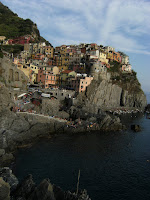 Sun, sea, cliffs, tiny ports, formaggio and vino. Cinque terre probably could be entered into the Oxford dictionary of English to describe the word "pictoresque".
The most famous inhabitant of the (very) small town of Manarola was the lemon tree right across the road from our B&B. Groups of visitors stopped outside for a photo opportunity of the said member of local flora.
3. Genova
We stayed in the most delightful B&B in the heart of the old town. It was a cute converted attic apartment in an ancient building consisting of 4 double rooms, a lovely spacious kitchen and a quirky roof terrace accessed through the kitchen window onto a narrow ledge, past the drain pipes and up a narrow flight of steps onto the most spectacular little sun trap in the entire city of Genova. I urge you to check out the pictures in picasa to see it for yourselves, it was incredible. The building itself didn't have a lift (but one was going to be installed, I witnessed the public notice of works downstairs next to the entrance) which made the experience of dragging your luggage up to the 5th floor with the temperature raising by about 5 degrees celsius after each flight of steps, well, quite an effort. It was all worth it though.

Genova could be described as having bags of gritty appeal, the old town with its narrow streets, the port, the prostitutes.... it's a working city in more ways than one. For high culture, via Garibaldi is a Unesco listed street with palaces built by the Italian aristocracy in the Genoese heyday, around the 16th century (pictured).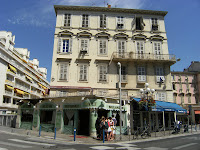 Palm trees, pretty pastels and frilly french balconies en masse. NB the re-assuring queue outside a boulangerie (pictured). Dining al fresco in Vieux Nice is not to be missed, I had the lushest fried sardines known to mankind there. Enjoying their meal in the table next to me was an unlikely couple (I thought: a classy lady with a toyboy) who turned out in fact to be mother and son, the latter doing his training in the kitchen of a Parisian 3 Michelin star restaurant, the former visiting him all the way from Brasil. There was something about the way they shared a cigarette after the starter that made me think otherwise. Anyway, no wonder I couldn't figure out what language they spoke, it sounded nothing like the Portuguese I heard in Portugal last October.
It was a funny co-incidence that the mother and son were doing almost the exact same journey I was, only in reverse order: from Paris they had headed South to Marseille, from there along the corniche to Nice where out paths crossed, and were going to continue to Italy! On their recommendation I resolved to visit Cassis (just East of Marseille) and in return I gave them the number of the delightful B&B in Genova described above.
5. Marseille
In a word, Marseille is massive.
 The whole experience of Marseille was rather dominated by my stay in the iconic Unite d'Habitation (Hotel le Corbusier, rooftop pictured), not only because it is such a mould-breaking building, but also because it is well off the beaten track so I found myself having to travel miles to get to the vieux port and the other touristy parts of town.
The touristy thing to do in Marseille is to visit Cassis (a tiny fishing town turned into a bit of a middle-class day trip destination), where you drink A.O.C Cassis ("blanc de blancs") on the beach, and catch a boat to visit les Calanques (tick).
However, Marseille couldn't really be described as touristy. The Marseillais have their very own Arndale centre (le centre commercial Bourse), and the city is more or less covered in graffiti. The metro is very retro indeed, and as with all other public forms of transport, it stops around 9 pm (this I found out the hard way, typically, and still find it incredible given that their dining habits are the same as everyone else's in the Med, ie late). On the bright side, you can access public transport bicycles, but you need your credit card to do this which I didn't have with me the first night...
Anyway, the Marseillais are wonderful, they speak French to you no matter how badly you speak French back to them (a refreshing change since in Nice, they all spoke English back to me as soon as I said "bonjour"). Also, they are very friendly and approachable (perhaps with the exception of the quey-side cafes where posh ladies with big jewellery and small dogs can be found in abundance), I was a bit paranoid first as random people would greet me in the street for no apparent reason. On the last night, I owe my fantastic bike ride along the corniche J.F. Kennedy to la plage du Prado to a friendly local who (seeing me struggle with the task) helped me operate the state of the art system to get on my bike.
The most bizarre element of the entire holiday was Hotel Le Corbusier/Unite d'Habitation, in its' entirety. It's like an ode to modernity and people who live there "live the utopia". Visiting the famous rooftop one gloriuos morning I spotted some folks dressed in old-fashioned white t-shirts doing their 1950's style weight lifting and other healthy exercises. In addition, no formal signing-in was required at the reception, I just told them my name and they took me to my room. I could have been anyone. To add to the strangeness, a different man at the reception when I was "checking out" (ie handing back my key and 138 euros in cash) advised me that Finnish people are asian. He assured me that he has several books on the topic and that this really is the case. Maybe he's right?
The height of weirdness was the nocturnal visit from some unidentified French guy into my room at approximately 12.30 am the first night: I was in bed, asleep, and woke up to the sound of keys rattling against the outer door which lead into this shared foyer between my room and next door. Right, I thought, the neighbour has arrived back from late dinner. Only that the rattling of the keys in the second door sounded far too loud. Before I could really think properly, the door opened and a man walked into the room, rested his shopping bags on the floor and flicked all the lights on. "Pardon, je suis trompe!" he exclaimed, seeing me gawking at him from between the sheets, grabbed his shopping bags, turned on his heels and made his swift way out.
Thankfully, he swithed the lights off again before he left the room so I didn't have to get out of bed.
The end.
The other general observation I believe is key to a harmonius holiday anywhere: do not moan about tourists or prices because: a) you are a tourist yourself, therefore b) expect to pay over the odds. When you then feast for 5 euros because you stumbled across a bar that does an early evening aperitivo deal, full of locals, it's an added bonus.
I had the most extraordinary things happening to me, too many really to recap in just one post, if you can't be bothered reading this then just check out the slide show on picasa. I try my best to be succinct (me?) and reduce the whole experience into a few highlights divided into five chunks mirroring the locations that I based myself in during those 8 days: Cinque terre, Genova, Nice and Marseille, and one part dedicated to the memorable arrival as follows:
1. Arrival (Pisa)
The most noteworthy thing was the heat, from the moment of touch down at Pisa airport at 7.35 pm on Wednesday 6 August. I didn't think I'd last for 8 days in those kind of temperatures (it was still +32 at that hour of the evening) but strangely one gets used to it, and by the time I reached Marseille I was cycling, taking un-airconditioned local trains and not feeling in any way restricted by the hot weather.
The incident that has to be recorded here sums up the most eventful 15 minutes of the year thus far: I had an ambitious plan to catch the 8.06 pm train from central Pisa to La Spezia, given that at 7.45 pm I was still waiting for my luggage in the arrivals hall, I didn't think I'd make it.
I jumped into a taxi at 7.52 pm, untypically for Italy the traffic was unproblematic so I reached the station at 8.00 pm. Untypically still, there was no queue at the ticket office, so when I was rushing up the stairs awkwardly with my luggage towards the platform with about a minute and a half to spare, I had no intention to turn around when I heard someone shouting "signora, signora". When I reached the platform I could still hear the persistent voice behind me so I turned around and saw a chubby man with an impressive moustache roughly in his late 50's hopping up the stairs and waving his arm in the air. Hang on, is that my purse he is clutching in his hand? He was huffing and puffing and speaking with great speed in Italian to two ladies witnessing the bizarre event, whilst handing my purse back to me. Undoubtedly he was explaining how he saw a pickpocket at work in the tunnel under the platforms and his heroic confrontation of the thief (I indeed spotted a suspicious looking teenage girl in the tunnel but I was too much in a hurry to clock that my shoulder bag was unzipped and my purse in full view after having just bought the train ticket, and also I heard some commotion behind me but again I was undeterred from my mission to catch the train).
The strange man with a moustache saved my holiday, the train pulled in, and all I could say was "grazie, grazie" and hurry on to the train. The purse still contained all my bank and visa cards, my driving licence, NI card, a substantial amount of euros (enough to last me for 8 days).
My faith in the human race is restored.
2. Cinque terre
 Sun, sea, cliffs, tiny ports, formaggio and vino. Cinque terre probably could be entered into the Oxford dictionary of English to describe the word "pictoresque".
The most famous inhabitant of the (very) small town of Manarola was the lemon tree right across the road from our B&B. Groups of visitors stopped outside for a photo opportunity of the said member of local flora.
Cinque terre was the main venue of the honeymoon, so one of the first things my friend announced as we met at La Spezia station went something like this: "fear not, the sheets have been changed this morning, but us girls will have to do with one big sheet to sleep with, despite my repeated requests for two single sheets for the double bed that we would share".
As Nicola would say, worse things happen at sea.
Va bene!
3. Genova
We stayed in the most delightful B&B in the heart of the old town. It was a cute converted attic apartment in an ancient building consisting of 4 double rooms, a lovely spacious kitchen and a quirky roof terrace accessed through the kitchen window onto a narrow ledge, past the drain pipes and up a narrow flight of steps onto the most spectacular little sun trap in the entire city of Genova. I urge you to check out the pictures in picasa to see it for yourselves, it was incredible. The building itself didn't have a lift (but one was going to be installed, I witnessed the public notice of works downstairs next to the entrance) which made the experience of dragging your luggage up to the 5th floor with the temperature raising by about 5 degrees celsius after each flight of steps, well, quite an effort. It was all worth it though.

Genova could be described as having bags of gritty appeal, the old town with its narrow streets, the port, the prostitutes.... it's a working city in more ways than one. For high culture, via Garibaldi is a Unesco listed street with palaces built by the Italian aristocracy in the Genoese heyday, around the 16th century (pictured).
On Sunday 10 August the honeymoon officially ended and my friend returned chez elle, and I continued on to France by train.
4. Nice
 Palm trees, pretty pastels and frilly french balconies en masse. NB the re-assuring queue outside a boulangerie (pictured). Dining al fresco in Vieux Nice is not to be missed, I had the lushest fried sardines known to mankind there. Enjoying their meal in the table next to me was an unlikely couple (I thought: a classy lady with a toyboy) who turned out in fact to be mother and son, the latter doing his training in the kitchen of a Parisian 3 Michelin star restaurant, the former visiting him all the way from Brasil. There was something about the way they shared a cigarette after the starter that made me think otherwise. Anyway, no wonder I couldn't figure out what language they spoke, it sounded nothing like the Portuguese I heard in Portugal last October.
It was a funny co-incidence that the mother and son were doing almost the exact same journey I was, only in reverse order: from Paris they had headed South to Marseille, from there along the corniche to Nice where out paths crossed, and were going to continue to Italy! On their recommendation I resolved to visit Cassis (just East of Marseille) and in return I gave them the number of the delightful B&B in Genova described above.
5. Marseille
In a word, Marseille is massive.
 The whole experience of Marseille was rather dominated by my stay in the iconic Unite d'Habitation (Hotel le Corbusier, rooftop pictured), not only because it is such a mould-breaking building, but also because it is well off the beaten track so I found myself having to travel miles to get to the vieux port and the other touristy parts of town.
The touristy thing to do in Marseille is to visit Cassis (a tiny fishing town turned into a bit of a middle-class day trip destination), where you drink A.O.C Cassis ("blanc de blancs") on the beach, and catch a boat to visit les Calanques (tick).
However, Marseille couldn't really be described as touristy. The Marseillais have their very own Arndale centre (le centre commercial Bourse), and the city is more or less covered in graffiti. The metro is very retro indeed, and as with all other public forms of transport, it stops around 9 pm (this I found out the hard way, typically, and still find it incredible given that their dining habits are the same as everyone else's in the Med, ie late). On the bright side, you can access public transport bicycles, but you need your credit card to do this which I didn't have with me the first night...
Anyway, the Marseillais are wonderful, they speak French to you no matter how badly you speak French back to them (a refreshing change since in Nice, they all spoke English back to me as soon as I said "bonjour"). Also, they are very friendly and approachable (perhaps with the exception of the quey-side cafes where posh ladies with big jewellery and small dogs can be found in abundance), I was a bit paranoid first as random people would greet me in the street for no apparent reason. On the last night, I owe my fantastic bike ride along the corniche J.F. Kennedy to la plage du Prado to a friendly local who (seeing me struggle with the task) helped me operate the state of the art system to get on my bike.
The most bizarre element of the entire holiday was Hotel Le Corbusier/Unite d'Habitation, in its' entirety. It's like an ode to modernity and people who live there "live the utopia". Visiting the famous rooftop one gloriuos morning I spotted some folks dressed in old-fashioned white t-shirts doing their 1950's style weight lifting and other healthy exercises. In addition, no formal signing-in was required at the reception, I just told them my name and they took me to my room. I could have been anyone. To add to the strangeness, a different man at the reception when I was "checking out" (ie handing back my key and 138 euros in cash) advised me that Finnish people are asian. He assured me that he has several books on the topic and that this really is the case. Maybe he's right?
The height of weirdness was the nocturnal visit from some unidentified French guy into my room at approximately 12.30 am the first night: I was in bed, asleep, and woke up to the sound of keys rattling against the outer door which lead into this shared foyer between my room and next door. Right, I thought, the neighbour has arrived back from late dinner. Only that the rattling of the keys in the second door sounded far too loud. Before I could really think properly, the door opened and a man walked into the room, rested his shopping bags on the floor and flicked all the lights on. "Pardon, je suis trompe!" he exclaimed, seeing me gawking at him from between the sheets, grabbed his shopping bags, turned on his heels and made his swift way out.
Thankfully, he swithed the lights off again before he left the room so I didn't have to get out of bed.
The end.
Subscribe to:
Posts (Atom)